Saturday, February 29, 2020

Where is Pride in our Relationsips


How is pride detrimental to relationships, especially in marriage? This is a question I want to explore today. In the following quote, “Pride is a sin that can readily be seen in others but is rarely admitted in ourselves .....we discover that it is a hard thing to recognize pride in our own hearts. Perhaps it is the nature of man to strain to see the mote in our brother’s eye while struggling to squinting past the beam in our own eye. (see Matt. 7:3-5). Selfishness is one of the more common faces of pride (Benson) and we can see how pride affects relationships because it is based on selfishness and it is all about me and not all about us. What does pride look like in marriage? Here are some things to think about and evaluate in our own relationships: (Goddard)
  • Thinking your partner needs to be fixed because they are flawed in some way
  • Focusing on our own needs and making our needs the priority in our marriage
  • When we are “feeling irked, annoyed, or irritated with our spouse” (p. 69)
  • Thinking everyone else needs to change
  • When you view marriage as only being a relationship that should bring pleasure, insight, satisfaction, and fulfillment to yourself
  • When we have our own vision of truth and imagine that no one else can see this truth as clearly as we can
  • When we feel we know our partners better than they know themselves
  • When we are always innocent, and they are always guilty
  • When we analyze and study past experiences looking for ways we were violated
  • When “we continue to grieve over our injuries and rehearse our opponents' offences” (p. 74)
  • Feeling there is no way to fix your marriage
  • Going through “cycles of correction and paybacks” p. (78)
  • Allowing concerns and irritations to turn into judgments
  • When we leave no allowances for our partner
  • When we have “narrow, trivial, superficial demands” that our partner should look, act and be what media says they should be (p. 82)


So, what do we do to rid pride from our relationships? President Benson has reminded us that “God will have a humble people. Either we can choose to be humble or we can be compelled to be humble.” (Benson)

He goes on to say, “Let us choose to be humble.” He gives us nine ways we can be humble:
  1. We can choose to humble ourselves by conquering enmity toward our brothers and sisters, esteeming them as ourselves, and lifting them as high or higher than we are.
  2. We can choose to humble ourselves by receiving counsel and chastisement.
  3. We can choose to humble ourselves by forgiving those who have offended us.
  4. We can choose to humble ourselves by rendering selfless service.
  5. We can choose to humble ourselves by going on missions and preaching the word that can humble others.
  6. We can choose to humble ourselves by getting to the temple more frequently.
  7. We can choose to humble ourselves by confessing and forsaking our sins and being born of God.
  8. We can choose to humble ourselves by loving God, submitting our will to His, and putting Him first in our lives.
  9. We must yield “to the enticing’s of the Holy Spirit,” put off the prideful “natural man,” become “a saint through the atonement of Christ the Lord,” and become “as a child, submissive, meek, humble.”
By doing these things we can see our own flaws and start working on our own problems and leave our partners problems alone. When we work on fixing ourselves, we become humbler, more able to see our partners for who they really are, the person we fell in love with. Humility helps us love deeper, give more and expect less. We become grateful for our spouse and appreciate all they are and how they love us back. It gives us the ability to love deeper and to find more fulfillment in our relationships. It helps us realize the changes we need to make in ourselves and allows us to move forward in a happier way. I hope we can all focus on being humble, forgiving, more loving and grateful for our partners.

References
Benson, Ezra T. Beware Of Pride. Ensign, May 1989.
Goddard, H. W. Drawing Heaven Into Your Marriage. (2009). Cedar Hills, UT: Joymap Publishing.

Friday, February 21, 2020

Making Bids In Marriage

Turn Toward Each Other Instead of Away

In marriages, couples are constantly making what Gottman calls “bids” for each other’s “attention, affection, humor, or support” (p 88). Bids are an attempt from one partner to another for a positive connection. They can be as simple as a smile, a touch, or asking for help or advice.

A couple examples of bids could be things like waking up with your spouse and rolling over to snuggle up to them, sharing how much you love waking up beside them every morning. Or it could be when you spouse asks you if you would like to go a walk with them. The way you answer the bid is by turning toward your spouse or turning away from them. In turning toward your spouse with the first example of waking up next to them, you could answer your spouse by pulling them in close and responding with words of affection. 

Turning away would look like quickly getting out of bed and not acknowledging the bid that was given to you because you are in a hurry to get a start to the day. Turning toward your spouse is an intentional act. Turning away can seem intentional, but most of the time the bid given is not understood or acknowledged. The goal is to be in tune with your spouse and watch for the bids and turn towards them. 


Couples who turn toward each other are connecting and attuning to each other which builds mutual trust in their relationship (Gottman 87) Gottman shares, “A tendency to turn toward your partner is the basis of trust, emotional connection, passion, and a satisfying sex life… Real-life romance is kept alive each time you let your spouse know he or she is valued…everyday” (p 88).

Some examples of things couples can do to turn toward their spouses are: (ideas taken from https://www.gottman.com/blog/the-sound-relationship-house-turn-towards-instead-of-away/ )

  •  You are reading the paper over breakfast and your partner makes a passing comment about a meeting they have at work that day. Follow up on what they said (put down that paper!) and give them your attention for a minute.
  • You are walking together, and you see that your partner looks cold. Stop into the nearest coffee shop and get them a warm beverage!
  • Your partner is leaving to go somewhere. Tell them to come see you before they go. When they come to see you, give them a six-second kiss.
  • You see that your partner looks stressed. Let them know you’ve noticed and ask them if they’d like to talk about what they are feeling.
  • Your partner sends you a text message about something, anything. Send them one back that lets them know how irresistible they are to you.
  • Compliment your partner about something they did. Compliment your partner about their appearance. Thank them for something they’ve recently done that you appreciate.
  • Your partner is back from their errand and is doing some housework. Without saying a word, join in and start helping them.
  • Your partner tells you that they are getting hungry. You tell them that you are too, and that you are going to take them out for dinner.
  • Your partner and you are talking after dinner, and they say how much they miss going out and dancing like you used to back in the day. Agree and recommend that you go out right now and dance.
  • Your partner is looking tired, but you are still having fun. You know that they have to be up early tomorrow to prepare for a meeting. Recommend that you go home so that they can get some rest.
  • You are in the bedroom and things are getting hot. Light some candles and tell them that you want to re-discover their body for an hour.

Think of some of your own ideas for bids that are applicable to your relationship with your spouse. Along with giving bids, make sure to pay attention to the bids that you are given, as there is always an underlying message behind each bid that is given. Remember to turn toward your spouse! Your relationship will be filled with greater love, happiness, and intimacy.


References:
Gottman, J. M., & Silver, N. (2015). The seven principles for making marriage work (2nd ed.). New York: Harmony Books.


Friday, February 14, 2020

Cherishing Your Spouse


 “Fondness and admiration are two of the most crucial elements in a rewarding and long-lasting romance. Although happily married couples may feel driven to distraction at times by their partners personality flaws, they still feel that the person they married is worthy of honor and respect.” (Gottman p.69)

What does it mean to be fond of someone or even admire them? Well, many dictionaries define fondness as liking someone, preferring them, you love them, and you have a warm affection for them. When you have admiration for someone, you honor and respect them. You look up to them, you approve of them, and you appreciate them.
Gottman suggests three things couples can do to enhance their fondness and admiration for each other. The first step is to start sharing appreciations for your spouse. You can start by making a list of all the things you appreciate about them and then start sharing them with your spouse. A few examples from Gottman’s book, The Seven Principles for Making Marriage Work, are: “Thanks for making dinner, it was delicious” or “I really appreciate you being so affectionate lately” or “Thanks for working so hard for our family” are all great things to say to your spouse to show you appreciate them (pg. 75). What appreciations can you share with your spouse today? Try setting a goal of giving at least one appreciation every day to your spouse.

The second thing is to talk about is “Your history and philosophy of your relationship”. This is done by talking about how the two of you met, what your first impressions of each were and talk about the positive memories of your wedding and first year of marriage. Talk about moments in your marriage that stand out the most to you, good and bad and why. (pg. 77-78) 


You will need some time together to really reminisce and remember the reason you got married in the first place. This is a great way to recharge your relationship and help foster fondness and admiration for each other.

The third thing is to cherish your partner. 


“Cherishing is a habit of mind in which, when you are separated during the course of the day, you maximize thoughts of your partner’s positive qualities and minimize thoughts of negative ones. This active focusing on your partner’s merits allows you to nurture gratefulness for what you have instead of resenting what is missing. Many couples do not realize they are neglecting to cherish each other.” (Gottman p. 78-79)

Gottman shares to make a list of at least ten qualities that your partner has and then say to yourself, “I am really lucky to be with my partner!” (pg. 79).  Things on your list may be things like “they are ambitious, brave, cheerful, creative, disciplined, friendly, honorable, kind, loving, loyal, patient, positive, quiet, resourceful, sincere, supportive, wise, and witty”. Only put positive qualities on your list. Once you have made your list you can write your spouse a love note telling them how much you cherish these qualities that they possess and how much it has blessed your life. You could even read it aloud to your spouse to make a romantic evening. (pg. 49-50)

If you and your spouse put these three things into practice you will find the quality of your relationship improve and your marriage will be greatly strengthened. Gottman suggests focusing on these three things for seven weeks so they become a natural part of your relationship, a more positive and healthy one.


References

Gottman, J. M., & Silver, N. (2015). The seven principles for making marriage work (2nd ed.). New York: Harmony Books.


Saturday, February 8, 2020

Your Best Friend

Who is your best friend? If you are married, did you automatically think of your spouse? Why or why not?
John Gottman, in his Book “The Seven Principles for Making Marriage Work” shared, “whatever the current state of your marriage, it will benefit enormously if you support, reinvigorate, or if necessary, resuscitate your friendship” (page 52). Why is friendship so important in marriage relationships?

Gottman states, “happy marriages are based on a deep friendship” meaning that couples have “a mutual respect for and enjoyment of each other’s company” and “they know each other intimately—they are well versed in each other’s likes, dislikes, personality quirks, hopes, and dreams. They have an abiding regard for each other and express this fondness not just in the big ways but through small gestures day in and day out” (page 21).

Friendship should be the foundation of love. It fuels the “flames of romance” because friendship protects against negative feelings towards each other and helps couples “feel optimistic about each other and their marriage…have positive expectations about their lives together…and to give each other the benefit of the doubt” (page 22).

My husband is definitely my best friend and I love spending time together with him. We enjoy different activities, but because we love spending time together, we have learned to compromise and do things we might not naturally enjoy otherwise. Take for example my husband’s love of backpacking. He loves it when I make an effort to go with him on backpacking trips, even though I don’t enjoy having a pack on my back or sleeping on a ground mat in a tent, I do love the time we have to ourselves and being in the great outdoors. He in turn does thing with me that I love doing. Friendship fuels our love and passion because of the intimate emotional connections we make with each other everyday. If your marriage is lacking in passion and intimacy, try working on your friendship and start rebuilding your emotional connection and you will see a mutual love, respect and passion rekindle in your marriage.

References:
Gottman, J. M., & Silver, N. (2015). The seven principles for making marriage work (2nd ed.). New York: Harmony Books.

Saturday, February 1, 2020

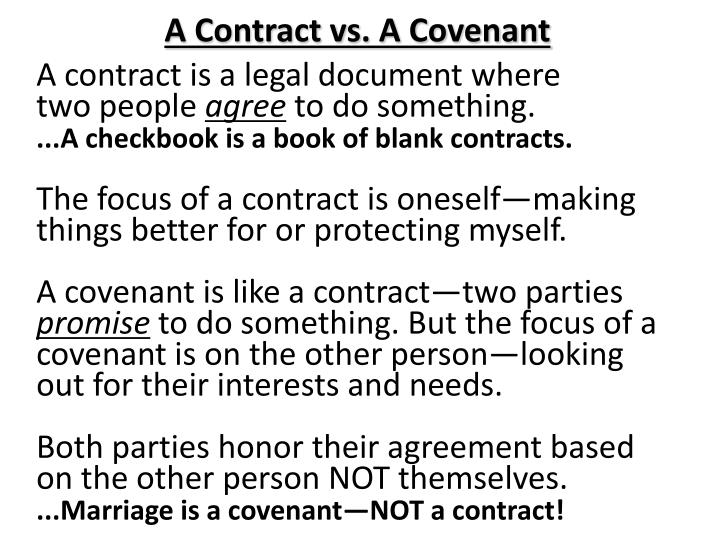
Contract verse Covenant Marriage

I have been watching a few marriages around me start to crumble…As I have been contemplating commitment in marriage, I thought about what Elder Bruce C. Hafen of the Seventy shared. He said, “When troubles come, the parties to a contractual marriage seek happiness by walking away. They marry to obtain benefits and will stay only as long as they’re receiving what they bargained for. But when troubles come to a covenant marriage, the husband and wife work them through. They marry to give and to grow, bound by covenants to each other, to the community, and to God. Contract companions each give 50 percent; covenant companions each give 100 percent. Marriage is by nature a covenant, not just a private contract one may cancel at will”. I love this explanation and I can see how marriages differ according to their level of commitment to each other.
Elder Hafen gives an example from the scriptures of the difference between the two in the story where “Jesus taught about contractual attitudes when he described the “hireling,” who performs his conditional promise of care only when he receives something in return. When the hireling “seeth the wolf coming,” he “leaveth the sheep, and fleeth … because he … careth not for the sheep.” By contrast, the Savior said, “I am the good shepherd, … and I lay down my life for the sheep.”  Many people today marry as hirelings. And when the wolf comes, they flee. This idea is wrong. It curses the earth, turning parents’ hearts away from their children and from each other.” (Hafen) Isn’t this an amazing thought. What do we do when troubles come into our marriage? Do we “lay our lives down” for the other person or do we “leaveth” our spouse because we do not care about them or our families? Sometimes a partner needs to leave the marriage due to very serious things, but generally speaking, we can do a better job of taking care of each other and our marriages and families.
There are three wolves that can bring trouble in marriage. “The first wolf is natural adversity.” (Hafen) This can be things like not being able to have children, illness or disability of a partner, or things that happen that were not expected in life. The second wolf is the imperfections of each spouse that will test them. Some examples of this is would be things like weaknesses, addictions, selfishness and attitudes. The third wolf is “the excessive individualism that has spawned today’s contractual attitudes” (Hafen). Attitudes like selfishness, not belonging to anyone, and doing it all on your own without thought of the other person would be considered aspects of excessive individualism because it is a self-centered focus instead of an outward focus on others. This comes from fear of rejection and not wanting to be hurt by anyone, so we build a wall around ourselves and protect ourselves by not letting anyone inside. This keeps us inside too, where we can’t help ourselves or others.

A contractual marriage will seek a way out of a marriage when these wolves show up because it is not easy to deal with. A covenant marriage will seek to work through challenges and help each other through trials and weaknesses. When two people marry, it should no longer be about two individuals making their way in life separately, it should become two individuals becoming one and making their life together, meeting challenges together, no matter what troubles may come their way. 

In summary, remember:


References

Hafen, Bruce C. “Covenant Marriage”. Ensign. Nov 1996. P. 26

Saturday, January 25, 2020

The Consequences of Redefining Marriage


Does same sex marriage threaten or affect my marriage? No, not really, but redefining marriage will have devastating effects on the future of marriage, children and society. On June 26, 2015, in OBERGEFELL ET AL. v. HODGES, a decision was made in the Supreme Court of the United States of America that will change history forever because they redefined marriage. This redefining of marriage gives equal rights to same sex marriages as marriages between persons of the opposite sex. The opposing four dissenting Chief of Justices shared, “This universal definition of marriage as the union of a man and a woman is no historical coincidence. Marriage did not come about as a result of a political movement, discovery, disease, war, religious doctrine, or any other moving force of world history—and certainly not as a result of a prehistoric decision to exclude gays and lesbians. It arose in the nature of things to meet a vital need: ensuring that children are conceived by a mother and father committed to raising them in the stable conditions of a lifelong relationship” (Roberts et al.). Marriage has always been about family, not just love choices. It is about creating life and continuing the population of this world. Redefining marriage has consequences that will not be fully understood or seen for another thirty years, as the next generation of children are raised without the traditional family support.
Jennifer Roback Morse shared, “Let me remind you of the essential public purpose of marriage: Marriage attaches mothers and fathers to their children and to one another. Once you replace that essential public purpose with inessential private purposes, marriage will not be able to do its job. But children will still need secure attachments to their mothers and fathers; a need which will go unfulfilled. You're redefining parenthood as a side effect of redefining marriage without even considering what it is you're about to do.” Children have a need and desire to have a relationship with both a father and mother as shown by a child of a loving gay parent, Katy Faust. Katy lived with her mom and dad until they divorced, and her mom had many female partners throughout her growing up years. Katy shares that although she loves her mother and her mother’s partners, she disagrees with the redefining of marriage. She said, “when it comes to procreation and child-rearing, same-sex couples and opposite-sex couples are wholly unequal and should be treated differently for the sake of the children. When two adults who cannot procreate want to raise children together, where do those babies come from? Each child is conceived by a mother and a father to whom that child has a natural right. When a child is placed in a same-sex-headed household, she will miss out on at least one critical parental relationship and a vital dual-gender influence. The nature of the adults’ union guarantees this. Whether by adoption, divorce, or third-party reproduction, the adults in this scenario satisfy their heart’s desires, while the child bears the most significant cost: missing out on one or more of her biological parents (Faust).
In “The Family, A Proclamation to the World” it states, “The family is ordained of God. Marriage between man and woman is essential to His eternal plan. Children are entitled to birth within the bonds of matrimony, and to be reared by a father and a mother who honor marital vows with complete fidelity.” When we go against God’s plan for the happiness of his children, we know there will be devastating consequences. Traditional marriage has been the fabric of society for thousands of years and it is only in the past couple of decades, since no fault divorce laws were passed, that we have seen the breakdown of our society. Without strong traditional families, the world as we know it, will continue disintegrate. When children are not raised by both a mother and a father, there are serious social consequences in society.
President Barack Obama shared, “We know the statistics that children who grow up without a father are five times more likely to live in poverty and commit crime, nine times more likely to dropout of schools, and 20 times more likely to end up in prison. They are more likely to have behavioral problems or run away from home or become teenage parents themselves, and the foundation of our community are weaker because of it.”
Ryan Anderson shares these thoughts before the Indiana House Judiciary Committee, “At one point in America, virtually every child was given the gift of a married mother and father. Those numbers right now, more than 50 percent of Hispanic children are born outside of wedlock; more than 70 percent of African American are born outside of wedlock. The consequences for those children are really serious. The state’s interest in marriage is not that it cares about my love life, your life, or anyone’s love life, just for the sake of romance. The state's interest in marriage is ensuring that those kids have fathers who are involved in their lives”.
Anderson also quotes Rutgers sociology professor, David Pocono, as saying, “The burden of social science evidence supports the idea that gender differentiating parenting is important for human development and the contribution of fathers to child rearing is unique and irreplaceable,” he then concludes, “we should disavow the notion that mommies can make good daddies just as we should disavow the popular notion that daddies can make good mommies. The two sexes are different to the core and each is necessary culturally and biologically for the optimal development of a human being.” 
If we are to see a successful world, we need to see successful families. When governments pass laws that do not support the traditional family as being the basic unit of society, it creates more problems for government to combat as shown by many voices. As a society we need to start putting value and protection for the traditional family. We need to get away from the idea of what is best for me and my love life and turn to what is best for me and my family and society. Selfishness has wreaked havoc on society, and it is time we look outward instead of inward.

References:
Anderson, Ryan. House Judiciary Committee Monday, January 13, 2014.
Morse, Roback Jennifer. Jennifer Roback Morse testimony to RI House Judiciary on marriage
Roberts, Scalia, Thomas. Obergefell v. Hodges, 576 U.S. (2015). Supreme Court of the United States pg. 44.

Saturday, January 18, 2020

Importance of Marriage to Families and Society


Paul R. Amato in his research, “The Impact of Family Formation Change on the Cognitive, Social, and Emotional Well-Being of the Next Generation” shared, “…children growing up with two continuously married parents are less likely to experience a wide range of cognitive, emotional, and social problems, not only during childhood but also in adulthood”(Amato, 2). What exactly does this mean, and how does a child’s upbringing determine their future lives? When families start to break down, so does society. The impact of the disintegration of families on society is wreaking havoc on children who are the future parents in this world.


Amato’s research shows how children raised in traditional two-parent families differs from children who are raised in single-parent families because “those who grow up in stable, two-parent families have a higher standard of living, receive more effective parenting, experience more cooperative co-parenting, are emotionally closer to both parents, and are subjected to fewer stressful events and circumstances”(Amato).  Stressful events and circumstances being things like, economic hardship, quality of parenting, and exposure to stress.
President Spencer W. Kimball warned people back in General Conference in October 1980, “Many of the social restraints which in the past have helped to reinforce and to shore up the family are dissolving and disappearing. The time will come when only those who believe deeply and actively in the family will be able to preserve their families in the midst of the gathering evil around us.” From 1980 to 2000 the number of children born into single parent families more than tripled and continues to rise (Marquardt, 11). We need to do everything we can to preserve families and have social programs in place that teach children the importance of marriage and families as the world’s future depends upon it. Children and youth could be taught in school, community, and even church settings, the importance of marriage and family stability. Marriages preparation courses should be made readily available to couples wanting to get married and this would greatly improve chances of couples staying married because they will have learned some tools in how to make their marriages stronger.

References:
Amato, P. (2005). The Impact of Family Formation Change on the Cognitive, Social, and Emotional Well-Being of the Next Generation. The Future of Children, 15(2), 75-96. Retrieved January 14, 2020, from www.jstor.org/stable/3556564

Kimball, Spencer, W. (1980, November). Families Can Be Eternal. Ensign, 4.

Marquardt, E., Blankenhorn, D., Lerman, Robert I., et al. “The President’s Marriage Agenda for the Forgotten Sixty Percent,” The State of Our Unions (Charlottesville, VA: National Marriage Project and Institute for American Values, 2012).